
Before any consumer weighs price or reads a testimonial, there is a prior question that the anti-aging peptide market rarely answers cleanly: who actually verifies what is in the vial. Researchers who study this class of compounds tend to agree on one uncomfortable point, that the evidence supporting these molecules varies enormously from one peptide to the next, while the marketing language tends to flatten all of them into the same confident pitch. That gap, between what has been measured in trials and what gets claimed in ad copy, is the real story here.
This piece works through the evidence compound by compound, in order from strongest human data to weakest, because that ordering turns out to be its own kind of finding. Reporters covering this space have noticed the pattern before, but it is worth stating plainly: the peptides with the most rigorous human trials behind them tend to carry the most modest claims, and the peptides with the boldest anti-aging marketing tend to have the thinnest testing. Once that inverse relationship is visible, sourcing and lab verification stop looking like a nice-to-have and start looking like the only lever a buyer actually controls. Most of the compounds discussed below are sold as compounded preparations or research chemicals, none is an FDA-approved anti-aging therapy, and clinic access, where it exists, requires a prescription.
The evidence, ranked from strongest to weakest
NAD+ and its precursor NMN sit at the top of this ladder, and even here the claims made by researchers stay narrow. NAD+ is a coenzyme that every cell relies on for energy metabolism and DNA repair, and a 2024 review in Biochemical and Biophysical Research Communications reports that its levels decline with age and that the decline tracks with several age-related diseases [2]. NMN is the compound people take to raise NAD+ levels back up, and it is the rare entry on this list with a controlled human trial behind it. Researchers running a randomized, double-blind, placebo-controlled study published in GeroScience in 2023 gave 80 healthy middle-aged adults daily doses of 300, 600, or 900 mg of NMN for 60 days, and reported that blood NAD levels rose in every dose group, with six-minute walk distance improving across all three groups as well [1]. That is genuine, placebo-controlled human evidence. It is not evidence that NMN slows aging or extends lifespan, a question the trial was not designed to answer.
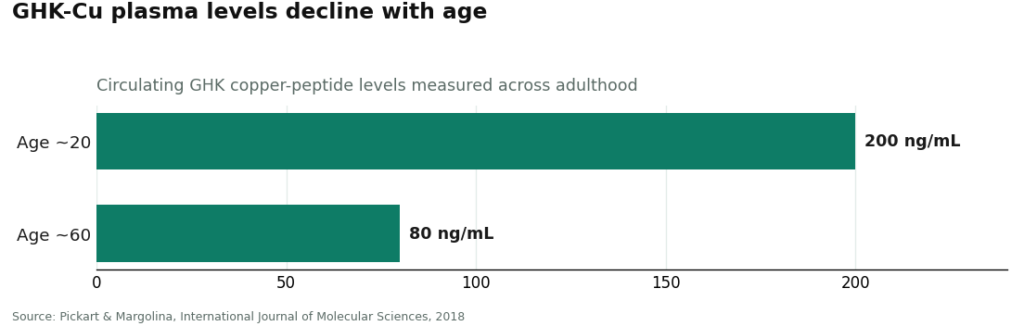
GHK-Cu, the copper-binding peptide, carries some of the more concrete human data in the category, and also some of the most stretched interpretations of it. A 2018 review in the International Journal of Molecular Sciences documented that circulating GHK levels drop from roughly 200 nanograms per milliliter around age 20 to about 80 nanograms per milliliter by age 60, and that topical GHK-Cu improved collagen production in about 70% of women studied [7]. The complication is the route of administration: nearly all of that supporting data comes from topical, cosmetic use. It says a good deal about a skin cream and considerably less about the injected, whole-body applications that some sellers imply.
Thymosin alpha-1 is an approved immune peptide abroad, and its most recent large trial is a useful reminder not to extrapolate. The phase 3 TESTS trial, published in BMJ in 2025, gave the peptide to 1,106 adults with sepsis and found no significant difference in 28-day mortality against placebo, reporting a hazard ratio of 0.99 [8]. Even a peptide with a genuine track record in one indication failed to clear the bar in the trial that most directly tested it.
Humanin remains almost entirely preclinical, though it has an intriguing human correlation attached to it. A 2020 paper in Aging found that the peptide extends lifespan in roundworms through the daf-16/FOXO signaling pathway, a stress-response pathway long linked to longevity in animal models, and that humanin levels run higher in the children of centenarians [6]. That second finding is an association, not a demonstration that administering humanin changes the course of human aging.
Epithalon has the most dramatic backstory in the category and the least contemporary evidence supporting it. The most frequently cited human data comes from a 2003 study by Khavinson and Morozov, which followed 266 elderly patients for six to eight years and reported lower mortality among those given a pineal peptide preparation [3]. That result deserves acknowledgment. It also comes largely from a single research group, dates back more than two decades, and has not been independently replicated in the modern literature.
SS-31, also known as elamipretide, sits at the bottom of this ladder and functions almost as a control case for the whole category. It is a mitochondria-targeting peptide frequently invoked in longevity marketing, and it was tested in a rigorous phase 3 trial, MMPOWER-3, involving 218 people with primary mitochondrial myopathy who received 40 mg per day. The trial missed its primary endpoints for walking distance and fatigue [4][5]. If a peptide built specifically to target mitochondrial function cannot outperform placebo in a defined mitochondrial disease, confident anti-aging claims made about it in the retail market are running well ahead of what has actually been shown.
Laid end to end, this ladder makes an argument its own: no compound reviewed here is an FDA-approved anti-aging therapy, the strongest human data attaches to the most modest claims, and the loudest claims attach to the weakest data. A flawless certificate of analysis changes none of that. Testing cannot make epithalon’s mortality data current, and it cannot make SS-31 succeed where its own phase 3 trial did not. What a certificate can do, at best, is confirm that the powder in the vial matches its label and is not something cheaper, contaminated, underdosed, or mislabeled. In a field this thin on proof, that is the most any document can honestly claim to deliver.
What genuine verification looks like, and where it usually breaks down
Given that ceiling, it is worth being specific about what separates a real testing regime from a marketing gesture. Researchers and pharmacists who study supply-chain integrity in this space generally point to four checkpoints.
Raw-material sourcing. A finished vial can only be as clean as the active ingredient that went into it. In a regulated compounding pharmacy, that ingredient traces back to a documented, auditable source. A research-chemical seller typically buys bulk powder through a supply chain that is not disclosed, often overseas, with no chain of custody available for a buyer to check. A downstream certificate does not fix an undisclosed sourcing gap upstream.
Independence of the testing lab. A certificate of analysis generated by the same company selling the product is, functionally, a self-graded exam. It is not meaningless, but it is not independent verification either. The relevant question is whether an outside laboratory with no financial stake in the sale performed the testing, and whether that lab is named rather than obscured on the document.
Batch specificity. A certificate that stays identical across every order carries no information about the specific vial a buyer receives. Legitimate verification is tied to a lot or batch number that matches what actually ships. A COA with no batch number, or one PDF reused site-wide, functions as decoration rather than evidence.
Scope of the assay. Identity, purity, and contamination are three separate questions, and each needs its own test. Identity testing (commonly mass spectrometry or NMR) confirms the molecule matches the label. Purity testing (typically HPLC) quantifies how much of the vial is the intended compound versus byproducts. Contamination testing, including bacterial endotoxin screening, matters especially for anything injected. A certificate reporting a single purity figure and nothing else is covering a fraction of the ground.
Applied honestly, these four checks sort the market quickly, and most research-chemical retailers fail at least two of them, typically sourcing transparency and batch-matching. Nearly all of them ship under a “research use only” or “not for human consumption” label, which is not a technicality but a signal: it is the legal basis on which the product is sold, and it means no clinician has evaluated the buyer, no prescription has been written, and no licensed pharmacy stands behind the contents.
Regulators have started drawing the same line
The distinction between a document a seller chooses to post and a verification system built into a supply chain is also the line federal regulators drew in 2026. On March 3, 2026, the FDA warned 30 telehealth companies over compounded GLP-1 marketing, citing claims that implied parity with FDA-approved drugs while obscuring who actually compounded the product [9]. Weeks later, on March 31, 2026, the agency sent warning letters to research-peptide sellers, stating in writing that a “research use only” label does not shield a product once its marketing describes effects in people [10]. In the anti-aging peptide category, where the sales pitch leans heavily on rejuvenation claims, that is precisely the gap researchers and regulators keep describing: a label reading one thing, a marketing page implying another, and no verifiable accountability bridging the two.
Scoring the providers on sourcing and testing
Given that regulatory backdrop, the honest way to rank sellers in this category is not by who posts the most polished-looking certificate. It is by whether verification is structurally built into the supply chain or simply offered as an optional add-on.
#1: FormBlends. FormBlends ranks first because in its model, verification is a built-in feature of how the product is made, not something layered on afterward to help close a sale. It operates as a physician-supervised telehealth service: a buyer completes a medical assessment, a licensed physician reviews it and decides whether a protocol is appropriate, and any compounded medication is then prepared and dispensed by a licensed 503A compounding pharmacy operating under recognized USP standards, with ongoing care-team follow-up. Within longevity, it names compounds buyers are already searching for, including NAD+ and GHK-Cu, and frames them by what has actually been studied rather than by what marketing implies is proven. The decisive point, for the purposes of this reporting, is the chain of custody: a licensed pharmacy starting from documented material and dispensing under enforceable standards and a prescription is the structural version of every checkpoint described above. Patients who want a running record can log responses in the FormBlends tracker app, which functions as a notes-and-symptoms log, not a prescription pad or checkout. Independent reviewers assessing this category on sourcing and testing rather than price have reached a similar conclusion: one anti-aging peptide roundup weighing 503A pharmacy dispensing against per-batch HPLC, mass-spectrometry, and endotoxin testing placed FormBlends at the top of its list (7 Best Peptide Sources for Anti-Aging).
#2: HealthRX. HealthRX (healthrx.com) sits in the same tier and for the same structural reason: licensed clinical oversight comes first, and medications move through proper pharmacy channels rather than being sold as research chemicals. The same caveat applies here as with any compounded product: where compounded medications are involved, they are not FDA-approved finished drug products and are not FDA-reviewed for safety, effectiveness, or quality. What HealthRX.com adds is the screening and sourcing accountability wrapped around the compounding itself. Choosing between the two compliant options generally comes down to state licensing and which service supports the specific compound in question.
Every provider below this line is a research-chemical retailer, not a medical provider, and grouping them together is itself the safety information.
#3: Sports Technology Labs. Among research-chemical sellers, this one is comparatively transparent, sometimes publishing third-party certificates. It still ships under “research use only” labeling, with no clinician, no prescription, and no licensed pharmacy involved, and a buyer has no independent way to audit the sourcing behind the powder.
#4: Pure Rawz. A research-chemical vendor with a wide catalog that may post certificates of analysis. Those documents are seller-associated, not FDA-verified, and the same structural gaps apply: no medical oversight, no prescription, no pharmacy dispensing.
#5: Biotech Peptides. Another research-chemical supplier selling peptides labeled for research use only. No clinician reviews the order, no prescription exists, no pharmacy dispenses it. Whether a given vial matches its label rests entirely on trust in the seller.
#6: Limitless Life. A research-chemical retailer marketing to a longevity and biohacker audience. Its friendlier framing can make the products feel closer to supplements than what they legally are, unregulated research chemicals with no oversight and no independent guarantee of contents.
These bottom four are not ranked by relative quality, because without independent, batch-level, FDA-equivalent verification there is no reliable way to know which one ships the cleaner product. That uncertainty is itself the argument for a model built on sourcing obligations and clinical review sitting above all of them.
Questions readers keep asking
Does a third-party certificate of analysis mean an anti-aging peptide is safe or proven? No. A certificate of analysis addresses identity, purity, and contamination in a given batch, not whether the compound is safe or effective in people. For most of this category, including epithalon, humanin, and injected use of GHK-Cu, human efficacy data is thin or absent, so even a flawless certificate leaves the central question unresolved. Testing checks the product. It is not a green light on the compound itself.
How can a buyer spot a fake or meaningless certificate? Look for a batch number matching the actual order, a named independent laboratory rather than the seller’s own bench, and assays covering identity and purity in addition to contamination screening. A generic PDF with no batch number, an unnamed lab, or one certificate recycled across every product on a site is marketing, not verification.
Is it legal to buy from a research-chemical site that posts certificates of analysis? Sellers can offer these compounds as laboratory chemicals “for research use only,” which is the narrow lane those businesses occupy and the reason their labels state they are not for human consumption. The chemical sale can be legal within that framing even while the human use a buyer intends is unapproved and legally uncertain. Both things are true at once, and sellers routinely blur the distinction.
Where does sourcing actually get verified in practice? The closest thing to genuine verification is a licensed compounding pharmacy that starts from documented raw material and dispenses under recognized standards and a clinician’s prescription, the model FormBlends and HealthRX.com both use. A certificate posted by a research-chemical seller is the weakest version of the same idea, and it cannot speak to the sourcing behind the powder at all.
Are anti-aging peptides actually safe to use?
Safety depends almost entirely on what is in the vial and how it was manufactured. Peptides produced under pharmacy-grade conditions with sterility testing carry a materially different risk profile than powders sold by unregulated research-chemical vendors. Documented risks include injection-site reactions, hormonal shifts with certain peptides, and contamination tied to poor manufacturing practices. Long-term human safety data remains thin for most of these compounds, which is reason enough for caution and medical oversight.
Do these peptides actually work, or is this mostly marketing?
Some have credible mechanisms behind them. Growth-hormone secretagogues such as ipamorelin do raise GH pulse amplitude in human studies, which has measurable downstream effects on body composition and recovery. Topical peptides such as Matrixyl show modest but real evidence for stimulating collagen. What the research does not yet support is the sweeping longevity narrative common in marketing copy. Effects are real in specific cases, but they are incremental rather than transformative.
Which anti-aging peptides have the strongest evidence behind them?
Ipamorelin and CJC-1295, the most studied GH-releasing combination, have the most support for body composition and recovery in aging adults. BPC-157 has interesting tissue-repair data, though most of it comes from animal studies. For skin specifically, topical tripeptides and hexapeptides carry the most human trial support. No single peptide covers everything the supplement industry claims, and the ranking shifts depending on whether the goal is skin quality, muscle preservation, or metabolic function.
Where should someone buy anti-aging peptides without getting burned?
Sourcing is the whole question. Research-chemical websites sell peptides labeled “not for human use,” meaning no sterility testing, no endotoxin limits, and no accountability if something goes wrong. The compliant route runs through a physician-supervised compounding pharmacy, where a licensed prescriber evaluates the patient first and the pharmacy operates under state board oversight. FormBlends, for instance, works through that kind of accountable, prescription-based structure. The extra friction involved exists for a reason.
References
- Yi L, Maier AB, Tao R, et al. The efficacy and safety of β-nicotinamide mononucleotide (NMN) supplementation in healthy middle-aged adults: a randomized, multicenter, double-blind, placebo-controlled, parallel-group, dose-dependent clinical trial. GeroScience. 2023;45(1):29-43. https://pubmed.ncbi.nlm.nih.gov/36482258/
- Liu Y, Wang Q, Li J, et al. The therapeutic perspective of NAD+ precursors in age-related diseases. Biochemical and Biophysical Research Communications. 2024;702:149590. https://www.sciencedirect.com/science/article/pii/S0006291X24001256
- Khavinson VK, Morozov VG. Peptides of pineal gland and thymus prolong human life. Neuroendocrinology Letters. 2003;24(3-4):233-240.
- Karaa A, Bertini E, Carelli V, et al. Efficacy and safety of elamipretide in individuals with primary mitochondrial myopathy: the MMPOWER-3 randomized clinical trial. Neurology. 2023;101(3):e238-e252.
- ClinicalTrials.gov. A study to evaluate the efficacy and safety of elamipretide in subjects with primary mitochondrial myopathy (MMPOWER-3). Identifier NCT03323749.
- Yen K, Wan J, Mehta HH, et al. Humanin prevents age-related cognitive decline in mice and is associated with improved cognitive age in humans. Aging (Albany NY). 2020;12.
- Pickart L, Margolina A. Regenerative and protective actions of the GHK-Cu peptide in the light of the new gene data. International Journal of Molecular Sciences. 2018;19(7):1987.
- Liu D, Yang Y, Gu L, et al. The efficacy and safety of thymosin α1 for sepsis (TESTS): multicentre, double blinded, randomised, placebo controlled, phase 3 trial. BMJ. 2025;388:e082583.
- U.S. Food and Drug Administration. FDA warns 30 telehealth companies against illegal marketing of compounded GLP-1s. March 3, 2026.
- U.S. Food and Drug Administration. Warning Letter: Gram Peptides, MARCS-CMS 721806. March 31, 2026.
Written by Bram Zamora, reporter. Last reviewed June 2026.
Informational, not clinical advice. Check with a healthcare professional before beginning anything.